



History
At Hadrian Academy, we achieve Excellence Together in History through following the National Curriculum and the scheme of work set out by Kapow.
Our History curriculum is made up of 3 knowledge strands and 2 disciplinary strands which can be seen in the diagram below about how they all support learning historical knowledge:
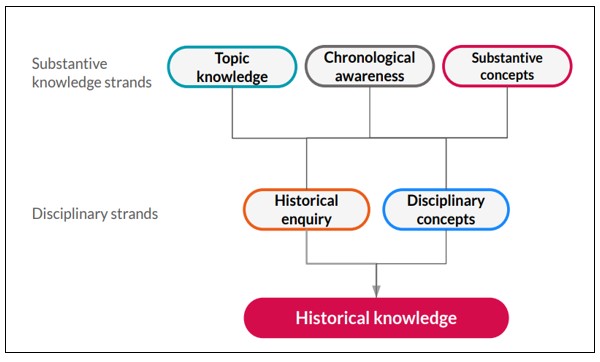
Our long term plan that outlines the units of learning can be found below.
Intent
Our History curriculum includes termly topics for all children from Year 1 Year 6. We aim to inspire pupils to be curious and creative thinkers who develop a complex knowledge of local and national history and the history of the wider world. We want our pupils to ask questions and be able to explain and analyse historical evidence.
Throughout their time at Hadrian, we aim for our pupils to develop an understanding of significant events in global and local history and how things have changed over time.
Through their History lessons, we aim for our pupils to appreciate the many reasons why people may behave in the way they do, supporting them to develop empathy for others while providing an opportunity to learn from mankind’s past mistakes.
Alongside this, our History curriculum aims to support pupils’ in building their understanding of chronology, making connections over periods of time and developing a chronologically-secure knowledge of History. In order to prepare pupils for their future learning in History, we aim to introduce them to key knowledge that will be built upon each year.
We aim to develop pupils’ understanding of how historians study the past and the skills used to carry out historical enquiries which the children will have the opportunity to replicate for their own enquiries.
We aim to support our pupils to meet the end of Key Stage attainment targets in the National Curriculum. For EYFS, the activities included allow pupils to work towards the Understanding the World Development Matters statements and Early Learning Goals which also cover foundational knowledge that will support them in their further history learning in Key Stage 1.
Implementation
Each six lesson unit has a focus on chronology to allow children to explore the place in time of the period they are studying and make comparisons in other parts of the world.
EYFS – children will reflect on their experiences from their own past, helping them understand that they each have their own histories.
KS1 – children will start to develop the ability to know where people and events fit chronologically.
KS2 – children will start to identify connections, contrasts and trends over time.
Each unit is phrased as an enquiry-based question and children are encouraged to follow the enquiry cycle (Question, Investigate, Interpret, Evaluate and conclude, Communicate) when answering these questions.
Our History curriculum follows a spiral curriculum model where previous skills and knowledge are returned to and built upon through recapping knowledge at the beginning of each unit and lesson and through using their historical skills in a range of contexts and time periods.
Each lesson is designed to be varied, engaging and hands-on, allowing children to experience the different aspects of an historical enquiry. They will be made up of activities allowing children to build their chronological awareness, historical concepts and the context of the time period being studied.
Lessons can be adapted to ensure accessibility by all pupils and to stretch pupils' learning when required.
History is taught for 45 minutes to 1 hour a week from Year 1 -Year 6. In EYFS, Geography is taught through continuous provision activities.
Impact
The impact of the history curriculum at Hadrian Academy can be monitored through both formative and summative assessment. Each unit has a skill catcher and knowledge assessment quiz which is used at the beginning of a unit to test the starting knowledge of the pupils and at the end to determine the progress made by each pupil.
Pupils should leave Hadrian equipped with a range of skills to enable them to succeed in their secondary education. They will be enquiring learners who ask questions and can make suggestions about where to find the evidence to answer the question. They will be critical and analytical thinkers who are able to make informed and balanced judgements based on their knowledge of the past.
The expected impact of following the Kapow History scheme of work is that children will:
- Know and understand the history of Britain, how people’s lives have shaped this nation and how Britain has influenced and been influenced by the wider world.
- Develop an understanding of the history of the wider world, including ancient civilisations, empires, non-European societies and the achievements of mankind.
- Develop a historically-grounded understanding of substantive concepts - power, invasion, settlement and migration, civilisation, religion, trade, achievements of mankind and society.
- Form historical arguments based on cause and effect, consequence, continuity and change, similarity and differences.
- Have an appreciation for significant individuals, inventions and events that impact our world both in history and from the present day.
- Understand how historians learn about the past and construct accounts.
- Ask historically-valid questions through an enquiry-based approach to learning to create structured accounts.
- Explain how and why interpretations of the past have been constructed using evidence.
- Make connections between historical concepts and timescales.
- Meet the relevant Early Learning Goals at the end of EYFS (Reception) and the end of key stage expectations outlined in the National curriculum for History at the end of Key stage 1 and 2.